
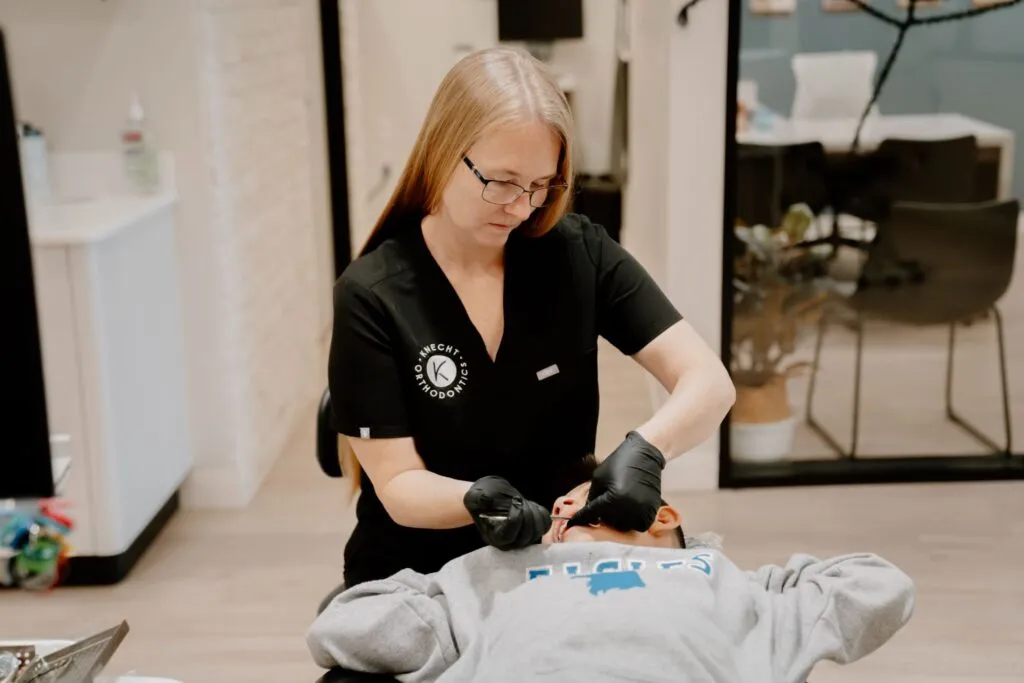
There is no single birthday when every child should start braces. There is a best age for the first orthodontic check, which is about 7, and there is a best window for treatment, which depends on what that check finds. For most Baytown kids, full braces or aligners start somewhere between 10 and 14. A smaller group benefits from an earlier, shorter phase while the jaw is still growing. Adults can start at any age.
This page walks through each stage the way Dr. Kristen Knecht explains it to parents at our Mont Belvieu office, a short drive up SH 146 from Baytown: what we look for at each age, what can be fixed early, and what is better left to wait.
Why the First Visit Happens Around Age 7
The American Association of Orthodontists recommends a first orthodontic evaluation by age 7. The reason is practical. By then most children have their first permanent molars and front teeth, so an orthodontist can see how the bite is coming together while the jaw is still growing and easy to guide.
A visit at 7 does not mean braces at 7. Most children we see at that age need nothing more than a check-in every so often. The visit sets a baseline so that, if a problem is developing, it gets caught while it is still simple.
At Knecht Orthodontics that first visit is free. It includes a comprehensive exam with a panoramic X-ray and photographs, plus a conversation about your child’s health history. Dr. Knecht also screens for signs of sleep-disordered breathing, such as snoring, mouth breathing, clenching and grinding, because jaw growth and airway health are closely linked.
Orthodontic Timing by Age
| Age | What is usually happening | What an orthodontist is deciding |
|---|---|---|
| 6–8 | Mixed baby and permanent teeth; first molars in | Is the jaw growing in balance? Is there a crossbite, severe crowding or a habit that needs attention now? |
| 7–10 | Jaw still growing quickly | Would a short early phase (an expander or partial braces) make later treatment simpler, or is it better to monitor? |
| 10–14 | Most baby teeth gone; permanent teeth arriving | When to begin full treatment so it lines up with the last baby teeth and the growth spurt |
| 15–18 | Permanent teeth in; growth slowing | Braces or aligners still work very well; some jaw-growth corrections are harder now |
| Adults | Growth finished | Teeth move at any age; gum and bone health and existing dental work shape the plan |
When Early Treatment (Phase One) Makes Sense
Early treatment, also called Phase One, usually starts between ages seven and ten. It is not a shortcut to a finished smile. Its job is to fix a problem that gets harder to fix once growth slows. Common reasons Dr. Knecht recommends it include:
- A narrow upper jaw or crossbite. An expander widens the upper jaw gradually while the palate is still growing. This makes room for incoming teeth and can help open the airway.
- Severe crowding. Creating space early can help permanent teeth erupt where they belong instead of becoming blocked.
- Bite problems that affect growth. Pronounced overbites, underbites and jaw shifts are easier to guide while the bones are still developing.
- Mouth breathing and airway concerns. When crowding comes with snoring, mouth breathing or poor sleep, Dr. Knecht may treat orthodontically and coordinate with your child’s other healthcare providers. Our airway orthodontics page explains that approach in more detail.
For some children, early treatment uses Invisalign First, a version of Invisalign designed for kids, instead of brackets. Whichever tool is used, Phase One is usually followed by a period of monitoring while the rest of the permanent teeth come in. Some children then need a shorter second phase. Others need nothing more.
When It Is Better to Wait
Plenty of children who come in at 7 or 8 are told to wait, and that is a good outcome. Mild crowding of the front teeth, small gaps and a bite that is developing normally are usually better handled in one phase of treatment later on. Starting early in those cases tends to add months in braces without adding much benefit.
Waiting does not mean ignoring it. We keep an eye on growth and tooth eruption at check-in visits, and we tell you plainly when the timing is right. If braces would just as easily start at 12 as at 9, we will recommend 12.
The Teen Window: Ages 10 to 14
For most patients, comprehensive treatment begins once most of the baby teeth are gone, usually between 10 and 14. This timing has two advantages. All the permanent teeth can be aligned at once, and the jaw is still growing enough that bite corrections are more predictable.
Teens at Knecht Orthodontics choose between KLOwen braces, in metal or ceramic, and Invisalign. KLOwen brackets are custom-designed from a 3D digital scan of your teen’s teeth, and metal brackets can be personalized with colored bands. Invisalign suits teens who want to remove their aligners for sports, band or photos and who will wear them as directed.
Is It Too Late at 16, 25 or 50?
No. Teeth move at any age. What changes with age is the jaw. Once growth is finished, some skeletal problems that could have been guided in childhood need different solutions. Straightening crowded teeth, closing gaps and correcting many bite problems all work well for older teens and adults. Many adults choose ceramic braces or Invisalign because they are less noticeable. The Baytown orthodontist page covers adult treatment for Baytown patients in more detail.
Signs Your Child Should Be Seen Sooner
You do not need to wait for a birthday. Book a visit if you notice any of the following:
- Baby teeth lost very early or very late
- Crowded, blocked-out or misplaced teeth
- Upper teeth that sit behind the lower teeth, or front teeth that stick out
- A jaw that shifts to one side when your child bites down
- Mouth breathing, snoring or restless sleep
- Thumb or finger sucking that continues past the early school years
- Trouble biting or chewing
What Happens at a Free Consultation
The visit starts with a conversation about your goals and anything that worries you. Dr. Knecht reviews your child’s dental and medical history, then takes a panoramic X-ray, photographs and, when useful, an iTero digital scan, with no impression putty. When she needs to see roots, jaw structure or the airway in more detail, the office also has CBCT 3D imaging.
You leave knowing which of three paths applies: no treatment needed for now, monitoring with periodic check-ins, or treatment, with the timing explained. If treatment is the right call and you are ready, same-day starts are often available. Our treatment coordinator walks through down payments, monthly payments and insurance. Knecht Orthodontics works with nearly all major insurance providers and helps file the paperwork.
For Baytown Families
Baytown families are a large part of our practice. The office is at 9115 Eagle Dr, Suite 300 in Mont Belvieu, a short drive up SH 146, and is open Monday through Thursday 8:00 a.m. to 5:00 p.m. and Friday 8:00 a.m. to 1:00 p.m. Call or text (832) 982-1281, or request a free consultation online. If your child is 7 or older and has never had an orthodontic check, now is a good time.
Frequently Asked Questions
What is the best age to get braces?
For most children, full braces start between 10 and 14, once most baby teeth are gone. Some children benefit from a short early phase between 7 and 10, and adults can start at any age. A first evaluation around 7 tells you which group your child is in.
Does seeing an orthodontist at 7 mean my child will need early treatment?
No. Most 7-year-olds need monitoring, not treatment. The visit is about timing. It catches the minority of problems that are easier to correct while the jaw is growing.
Can my child get braces before all the baby teeth fall out?
Yes, in specific situations. Expanders, partial braces and Invisalign First are designed for children who still have some baby teeth. Full comprehensive braces usually wait until more permanent teeth are in.
Does my child need a referral from our dentist?
No referral is needed. You can schedule a free consultation directly, and we are happy to keep your family dentist informed.
Is the first consultation really free?
Yes. The initial visit, including the exam, panoramic X-ray and photographs, costs nothing, and there is no obligation to start treatment.